Best Noise-Canceling Headphones for Focused Work
Compare six noise-canceling headphones for focus, calls and travel by comfort, battery, multipoint and connection options, then test fit and safe listening.
What to know first
- A visible plan reduces the cost of deciding what comes next.
- Protect a small number of focused work blocks.
- A consistent shutdown ritual keeps work from filling the evening.
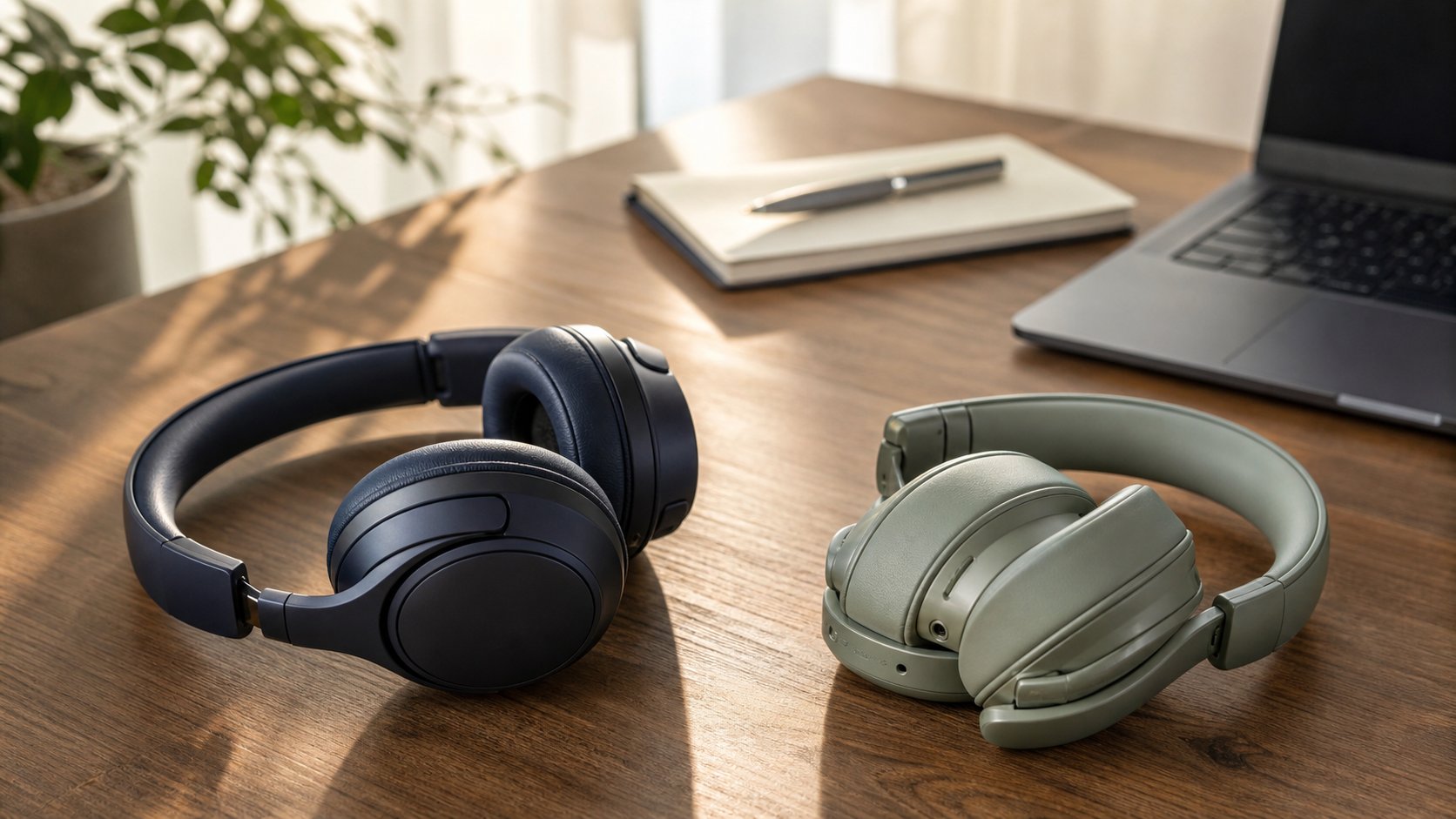
The best noise-canceling headphones for work must stay comfortable, switch reliably between devices and produce understandable calls—not only suppress airplane rumble. Sony WH-1000XM6 is the strongest all-purpose shortlist candidate. Bose QuietComfort Ultra Headphones (2nd Gen) offer a roomier premium alternative, while Jabra Evolve2 65 Flex prioritizes workplace calls and a certified USB connection.
Active noise cancellation varies with fit, glasses, hair and the type of sound. It is generally most effective on steady low-frequency noise and cannot guarantee silence or block every voice. RemoteNest did not perform acoustic or call-quality testing; the picks below combine current manufacturer specifications with clear work use cases.
Quick picks
| Headphones | Best for | Published battery headline | Main trade-off |
|---|---|---|---|
| Sony WH-1000XM6 | Best all-purpose premium option | Up to 30 hr with ANC | Expensive; no water-resistance claim |
| Bose QC Ultra (2nd Gen) | Comfort and adjustable ANC | Up to 30 hr in standard modes | Immersive modes reduce runtime |
| Bose QuietComfort | Simpler premium value | Up to 24 hr | Fewer flagship features |
| Sennheiser Momentum 4 Wireless | Long battery and sound | Up to 60 hr under specified conditions | ANC is not the sole design priority |
| Jabra Evolve2 65 Flex | Calls and managed work devices | Configuration-dependent | On-ear fit and business pricing |
| Apple AirPods Max USB-C | Apple integration | Up to 20 hr | Heavy, expensive and limited multipoint behavior |
Battery claims use different test methods and settings. Treat them as planning ceilings rather than guaranteed runtimes.
1. Sony WH-1000XM6: best overall shortlist
Sony’s WH-1000XM6 uses an adaptive 12-microphone noise-canceling system, multipoint Bluetooth and a folding design. Sony rates it for up to 30 hours of music with noise cancellation on and 40 hours with it off.
Best for: alternating between focused work, calls and travel.
Strengths: broad ANC controls, multipoint connection, analog input, fast charging and a relatively light 254 g published weight.
Trade-offs: premium price, touch controls and no suitability for sweat or rain. The earcup seal can change around glasses.
2. Bose QuietComfort Ultra Headphones (2nd Gen): best premium comfort alternative
The Bose QuietComfort Ultra Headphones (2nd Gen) provide Quiet, Aware and immersive listening modes, CustomTune calibration, Bluetooth multipoint and USB-C audio. Bose lists up to 30 hours in Quiet or Aware mode, with lower runtime when Immersive Audio is active.
Best for: a user who prioritizes plush fit and wants USB-C listening as well as Bluetooth.
Strengths: adjustable modes, folding construction and removable cushions.
Trade-offs: high cost, no water-resistance claim and a battery result that depends substantially on mode. Try the headband and clamp for at least an hour.
3. Bose QuietComfort: best simpler Bose option
The Bose QuietComfort Headphones offer Quiet and Aware modes, multipoint, analog listening and a published battery life up to 24 hours.
Best for: strong conventional ANC without paying for immersive-audio features.
Strengths: straightforward physical controls, folding case and established cushion design.
Trade-offs: the lower price varies by sale, and call performance still depends on room noise and conferencing software. Compare it with the newer 2nd Gen listing in your region, because Bose naming can be easy to confuse.
4. Sennheiser Momentum 4 Wireless: best for battery-first buyers
The Sennheiser Momentum 4 Wireless emphasizes sound quality and long endurance, with adaptive noise cancellation and multipoint connectivity. Sennheiser publishes up to 60 hours of playback under its stated test conditions.
Best for: long workweeks where charging frequency matters more than maximum isolation.
Strengths: battery life, app equalization, USB audio and analog cable support.
Trade-offs: listeners seeking the strongest possible ANC should compare it directly with Sony and Bose in their real environment. The touch interface also requires a short learning period.
5. Jabra Evolve2 65 Flex: best work-call system
The Jabra Evolve2 65 Flex is a business headset with a folding boom microphone, active noise cancellation and options for certified USB adapters.
Best for: a managed Windows or macOS work computer where call controls and platform certification matter.
Strengths: visible boom mic, busy light, compact folding design and USB-dongle options that can simplify enterprise support.
Trade-offs: on-ear cushions distribute pressure differently from around-ear models, and music-first buyers may prefer consumer headphones. Confirm whether the selected SKU is certified for Microsoft Teams or unified communications and whether it uses USB-A or USB-C.
6. Apple AirPods Max USB-C: best Apple integration
AirPods Max integrates automatic switching, spatial features and device controls across supported Apple hardware. The current USB-C version is rated for up to 20 hours with active noise cancellation and spatial audio enabled.
Best for: an Apple-centered workflow where ecosystem behavior matters more than price or low weight.
Strengths: transparency mode, device integration and a physical Digital Crown.
Trade-offs: heavier construction, premium price, limited cross-platform features and no conventional Bluetooth multipoint in the same sense as Sony, Bose or Sennheiser. Test headband pressure before committing.
Comfort matters more than a minor ANC difference
A headphone that is removed after 45 minutes cannot protect focus through a long work block. Evaluate:
- Clamp pressure at the jaw and temples
- Earcup depth around the outer ear
- Heat after one hour
- Headband pressure
- Seal with glasses
- Weight when looking down
- Control accessibility
Do not assume larger cushions are always cooler or more comfortable. Head and ear shapes vary. Buy from a seller with a practical return window and keep packaging until several normal workdays are complete.
ANC does not erase every distraction
Microphones sample surrounding sound and the electronics generate an opposing signal. This works especially well for predictable hums such as HVAC and engines. Irregular nearby speech, keyboard impacts and sudden sounds are more difficult.
Passive isolation from the earcup seal handles part of the higher-frequency range. Glasses, thick hair and a loose fit can reduce it. Sometimes low-level instrumental audio or appropriate background sound masks residual speech better than increasing ANC intensity.
Read the focus-music guide before using sound on language-heavy tasks.
Check call behavior, not only music
Bluetooth headphones can behave differently when the microphone becomes active. The operating system may switch profiles, audio quality can change and conferencing software may select the wrong input.
During the return period:
- Pair both work computer and phone.
- Join the actual meeting platform.
- Record speech in a quiet room.
- Repeat with fan or kitchen noise.
- Test mute from both headset and app.
- Receive a phone call while connected to the computer.
- Disconnect and reconnect after sleep.
A dedicated USB adapter can make enterprise call controls more predictable, but only when it is compatible and approved.
Understand multipoint limitations
Multipoint usually means two active paired devices, not simultaneous mixing from both. Behavior varies when:
- A phone notification interrupts a computer call
- One device retains a microphone session
- The conferencing app changes output
- A corporate VPN or Bluetooth policy applies
- High-resolution codecs are enabled
Read the manual for switching priority. Disable notification sounds on the secondary device if they repeatedly steal focus.
Wired, USB and analog modes
Bluetooth
Most convenient, with battery and wireless-profile constraints.
USB audio
Can provide a stable digital connection on supported models, but not every USB-C port on a headphone carries audio; some are charging-only.
Analog cable
Useful for backup and low latency. Some ANC headphones sound different or lose microphone functionality through the included cable.
Confirm what operates when the battery is empty. “Wired” does not always mean fully passive.
Use safe listening habits
The World Health Organization’s safe-listening guidance recommends keeping volume down, taking listening breaks and reducing exposure duration. ANC can help make lower playback levels usable in a noisy room, but it does not make loud audio safe.
Practical habits include:
- Start at the lowest useful volume.
- Take the headphones off during breaks.
- Use transparency mode where situational awareness is necessary.
- Never depend on ANC around traffic, alarms or machinery.
- Clean cushions and allow skin to dry.
Seek clinical advice for ringing, muffled hearing, pain or persistent dizziness.
When earplugs, speakers or room changes are better
Headphones are not the only option. Soft furnishings, door seals and moving away from appliances may reduce noise without wearing anything. Proper hearing protection is required for hazardous sound; consumer ANC headphones are not a substitute unless specifically rated for that use.
If pressure or heat is the problem, moderate speakers in a private room or a white-noise machine may be more comfortable.
Final recommendation
Choose Sony WH-1000XM6 for the strongest all-purpose specification set, Bose QC Ultra 2 for a premium comfort alternative, Bose QuietComfort for a simpler value choice, Momentum 4 for battery priority, Jabra Evolve2 65 Flex for managed call workflows and AirPods Max for an Apple-first setup.
Test fit for a full hour, run calls on the real computer and keep volume moderate. The best work headphones are the pair you can wear safely and reliably—not the model that wins one noise-cancellation measurement.