Home Office Tax Deductions: What Remote Workers Should Check
Understand home office tax deductions for employees and self-employed workers, including US eligibility, calculation methods, records and common mistakes.
What to know first
- Prioritize comfort and reliability over matching finishes.
- Used commercial-grade equipment can beat new budget gear.
- Leave room for one upgrade after you test the setup.
Home office tax deductions depend first on where you file and whether you are an employee, self-employed, a partner, a business owner or a combination. Working from home does not automatically make rent, internet, furniture or utilities deductible.
This guide explains a review process and gives a current United States example. It is general information, not personalized tax advice. Rules, forms, rates and deadlines change. Confirm the tax year with the official authority or a qualified local adviser.
Quick answer for US federal returns
As of September 27, 2026:
- Employees generally cannot claim the federal home-office deduction, even when an employer requires remote work.
- Qualifying self-employed taxpayers may claim it when the space meets business-use tests and other requirements.
- A qualifying area generally must be used regularly and exclusively for business, subject to specific exceptions.
- The simplified option uses $5 per square foot up to 300 square feet, for a maximum calculation of $1,500 before applicable limits.
- The regular method allocates eligible actual expenses and may include depreciation for owners.
The IRS confirms current employee ineligibility and self-employed rules in its home-office deduction guidance.
State rules may differ from the federal treatment.
Step 1: identify your work status
Employee
An employee receives wages through payroll. Buying a desk or using a spare room does not convert that person into a business.
US employees generally cannot take the federal home-office deduction on an individual return. They should review:
- Employer reimbursement policy
- Accountable-plan documentation
- Equipment ownership and return obligations
- State income-tax rules
- Required claims deadlines
Use the home office stipend guide to prepare a reimbursement request.
Self-employed individual
A sole proprietor, independent contractor or freelancer may be eligible to deduct qualifying ordinary and necessary business expenses. The home-office deduction adds specific requirements for the use of the home.
Both employee and self-employed
Only the qualifying business use relates to the self-employed activity. An employee job does not become deductible because a side business uses the same desk.
Shared use can make the exclusive-use test difficult. Keep activities and records distinct.
Partnership or corporation owner
Rules depend on entity structure, agreements and reimbursement arrangements. Do not assume the sole-proprietor method applies. Seek entity-specific advice.
Step 2: test the workspace
For the general US rule, ask:
- Is the area used regularly for the business?
- Is it used exclusively for that business, subject to limited exceptions?
- Is it the principal place of business, a place for meeting clients in the normal course, or a qualifying separate structure?
- Does the activity constitute a trade or business rather than an occasional hobby?
A separately identifiable area can qualify without a permanent wall, but personal use of the same area may fail exclusivity.
Examples that may fail:
- Dining table used by the household every evening
- Guest room that regularly hosts visitors
- Sofa where both work and personal television viewing occur
- Desk used for an employee job and unrelated side business without a clear qualifying allocation
Inventory storage and daycare can have different rules. Review current IRS Publication 587 or professional guidance.
Step 3: choose simplified or actual expenses
Simplified method
The current US simplified option uses $5 per square foot of qualified space, up to 300 square feet.
Advantages:
- Easier calculation
- Less home-expense allocation
- No home depreciation for that year
- No later recapture of home depreciation from simplified-method years
Limitations:
- Maximum area and calculation
- Gross-income limitation still applies
- No carryover of a simplified-method amount disallowed by the income limit
- The choice for a filed year generally cannot later be changed on an amended return
See the IRS simplified-option comparison.
Regular or actual-expense method
This method allocates eligible direct and indirect expenses.
Possible categories include:
- Rent
- Mortgage interest subject to rules
- Real estate taxes subject to rules
- Utilities
- Home insurance
- Repairs and maintenance
- Depreciation for the business portion of an owned home
Advantages: may produce a larger deduction when qualified actual costs are high.
Trade-offs: more records, allocation work, depreciation and possible future tax consequences.
The largest calculated amount is not always the best long-term choice.
Direct, indirect and unrelated expenses
Direct expense
Benefits only the business area. Example: painting the qualifying office.
Indirect expense
Benefits the whole home and may be allocated. Example: qualifying utilities or insurance.
Unrelated expense
Benefits only the personal area and generally is not part of the home-office calculation. Example: remodeling a personal bedroom.
Classification matters. Do not put every home purchase into an “office” folder and decide later that it was business-related.
Measure the space
For the regular method, business percentage may be based on area:
Business-use percentage = qualified office area ÷ total home area
In some circumstances, a room-count method may be reasonable when rooms are approximately equal, but measurement is usually clearer.
Keep:
- Dated dimensions
- Floor plan or sketch
- Photos showing the identifiable area
- Move-in or move-out dates
- Dates business use began and ended
- Records of any area change
A measurement supports the calculation; it does not prove exclusive and regular use by itself.
Equipment is not the same as the home-office deduction
A computer, desk, software subscription or printer may be a separate business expense rather than a cost of using the home itself.
Treatment can depend on:
- Business purpose
- Work-use percentage
- Useful life
- De minimis rules or capitalization policy
- Section 179 or depreciation eligibility in the US
- Listed-property or substantiation requirements
- Whether the employer reimbursed it
Do not combine every equipment purchase into Form 8829. Use the correct business-expense category and form.
The free remote-work expense tracker helps separate equipment, software, connectivity and home costs.
Internet and phone expenses
A self-employed taxpayer may be able to deduct the qualified business portion of internet or phone service under general business-expense rules.
Use a reasonable, supportable method. The full household bill is not automatically business use.
Keep:
- Monthly invoices
- Proof of payment
- Business-use method
- Separate-business-line records if applicable
- Reimbursement details
US rules for the first residential telephone line include special limitations. Ask an adviser how current rules apply.
Employee reimbursement
An employer reimbursement can be more valuable to an employee than an unavailable deduction.
Before buying:
- Read the written policy.
- Get approval.
- Use approved vendors if required.
- Keep itemized receipts.
- State the business purpose.
- Submit before the deadline.
- Record who owns the item.
- Return excess advances when required.
Tax treatment can depend on whether the arrangement satisfies local accountable-plan or expense-reimbursement rules.
Do not call a taxable stipend a reimbursement without confirming payroll treatment.
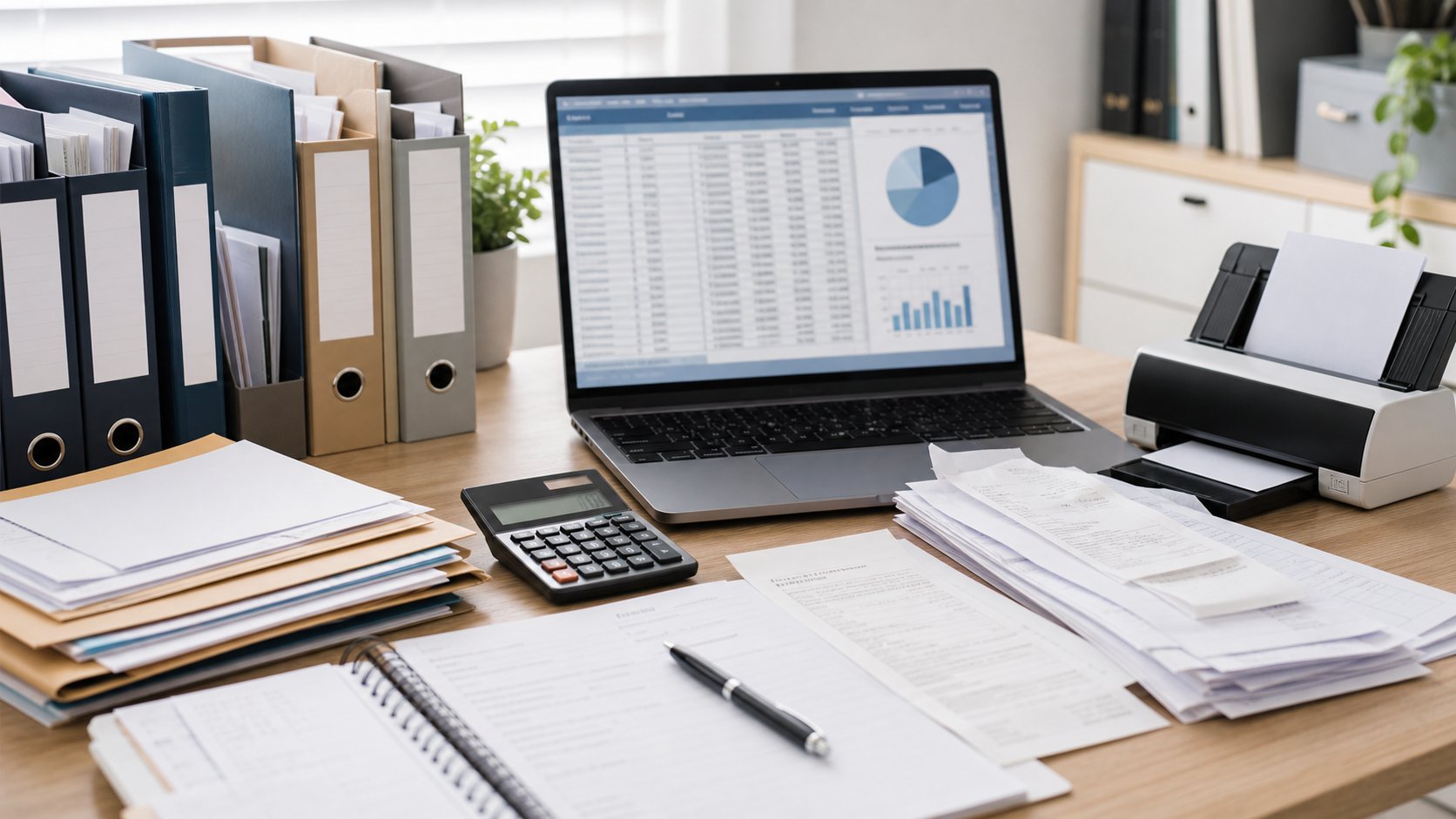
Records to keep
Create one folder for each tax year with:
- Receipts and invoices
- Proof of payment
- Floor measurement and calculation
- Utility and housing statements used
- Business-use explanation
- Reimbursement records
- Equipment model and serial numbers
- Depreciation schedules
- Prior-year carryovers
- Copies of filed forms and elections
- Advice received from a professional
Retention periods vary by record and jurisdiction. Follow official guidance. Property-basis and depreciation records may need to be kept longer than ordinary receipts.
Home sale implications
Using the actual method may involve depreciation, and allowed or allowable depreciation can affect gain calculations when an owned home is sold.
The simplified method avoids a home-depreciation deduction for years it is used, but prior actual-method depreciation does not disappear.
Home-sale rules are technical. Include historical home-office use when seeking sale advice.
Deduction limits and carryovers
A US home-office deduction generally cannot create or increase a business loss beyond applicable limits. The treatment of disallowed amounts differs between actual and simplified methods.
The current Schedule C instructions and Form 8829 explain ordering and carryover rules. Do not copy last year’s number without reviewing the supporting schedule.
Other loss, basis, passive-activity and at-risk limits may also apply.
International remote workers
Outside the US, the relevant questions remain useful even though the answers differ:
- Are employees eligible or only self-employed workers?
- Is employer-mandated remote work required?
- Must the room be exclusive?
- Is there a fixed daily or monthly allowance?
- How are utilities allocated?
- Is employer reimbursement taxable?
- What proof must be retained?
- Does cross-border work create payroll or permanent-establishment issues?
Use the official tax authority for the country and tax year. Cross-border residence, employer location and workdays can create issues beyond office expenses.
Common mistakes
Assuming remote work creates eligibility
Work location alone is not enough.
Claiming the full housing cost
Only a qualifying, calculated business portion may be relevant.
Using a shared room as “exclusive”
Personal use can disqualify the area under US rules.
Deducting an employer-owned purchase
You did not bear the cost if the employer paid directly.
Ignoring reimbursement
A reimbursed amount may not also be deductible by the worker.
Choosing actual expenses without tracking depreciation
This can create future errors.
Relying on social-media tax advice
Rules differ by status, state, country and year.
Mixing tax years
Use payment, accrual and placed-in-service rules applicable to your accounting method and item.
Year-end review checklist
- Confirm employment and entity status.
- Re-test regular and exclusive use.
- Measure qualified space.
- Reconcile expense records.
- Subtract reimbursements and refunds correctly.
- Compare simplified and actual methods where eligible.
- Review depreciation and carryovers.
- Check state or regional differences.
- Download current forms and instructions.
- Ask for professional advice before filing when facts are unclear.
Final recommendation
Start with eligibility, not receipts. US employees generally cannot claim the federal home-office deduction, while qualifying self-employed taxpayers may choose between simplified and actual-expense methods.
Keep business purpose, space use, reimbursement and equipment records throughout the year. Then apply the rules for the correct jurisdiction, status and tax year. A clean record does not guarantee a deduction, but it makes the right answer much easier to establish.